Tag Archives: traffic safety
2025 NC World Day of Remembrance
The 2025 NC World Day of Remembrance will be held at Durham Central Park on Sunday, November 16, 2025 at 2:00 pm. ITRE is partnering with the City of Durham, Bike Durham, and the NC Families for Safe Streets to host the 7th annual memorial exhibit.
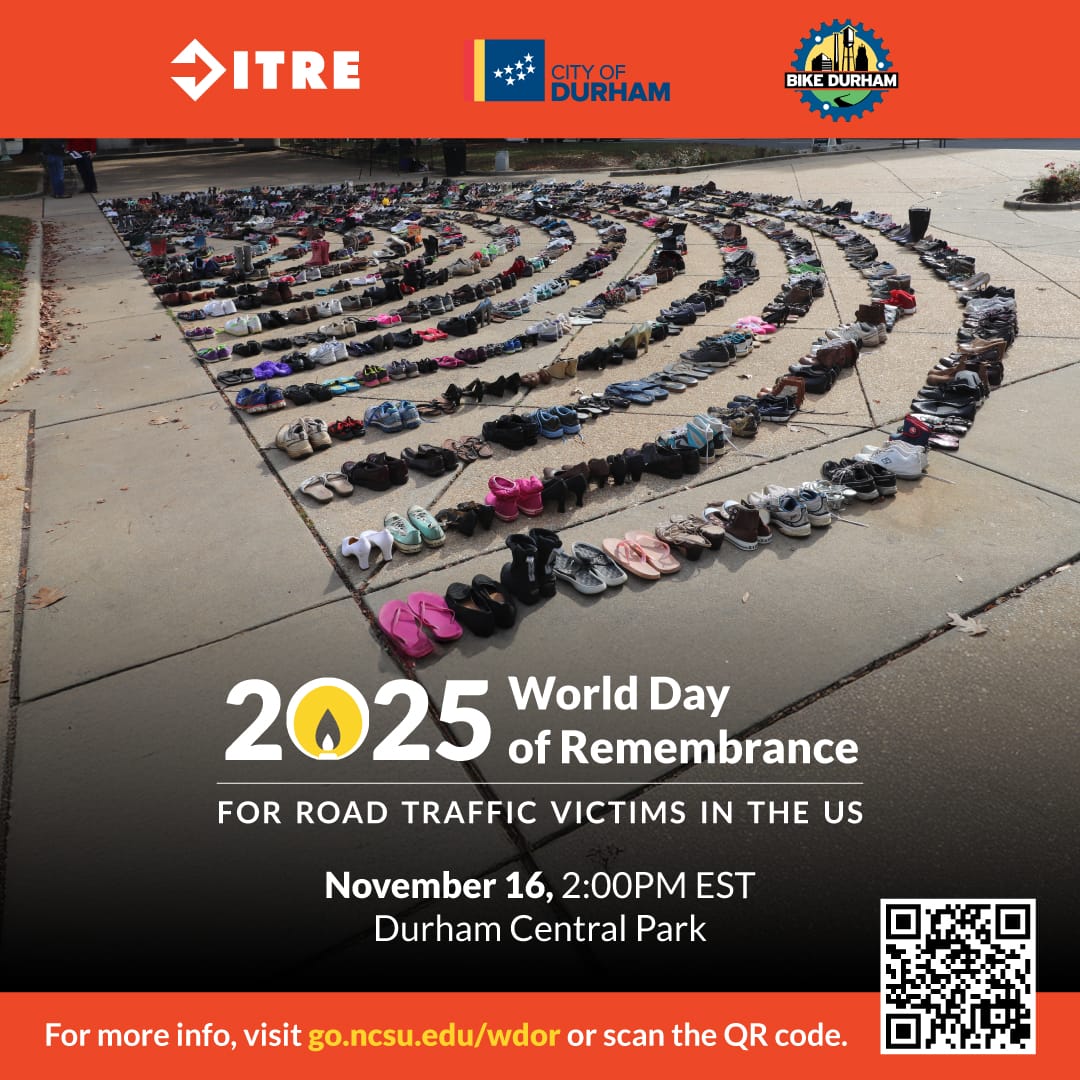
The exhibit will feature pairs of shoes to represent the 1,732 people killed on North Carolina roads last year. A press event at 2:00 pm will honor North Carolina crash victims and feature remarks from transportation leadership.
How to Participate
All are welcome to the shoe memorial exhibit and press event. We invite everyone to wear the color yellow, the official color of the global World Day of Remembrance.
If you have been seriously injured in a crash or would like to honor a lost loved one, you are also invited to share your story or contribute a photo to the event.
Please reach out to tracy_russ@ncsu.edu if you would like to dedicate a pair of shoes to a loved one, share your story, or contribute a photo.
Location Details
The shoe memorial exhibit will be displayed on “The Great Lawn” (the grassy hill between the skate park and “The Leaf”) in Durham Central Park. The area is wheelchair accessible.
Parking
There is free weekend parking along Foster St., W Seminary Ave, and Rigsbee Ave next to the park.
Restrooms
There are restrooms available in the nearby Durham Food Hall.
Sign up to receive updates about this event at the link below.
Safe Streets Week Day 6
Click here to download image.
If you were riding with a friend and they started using their phone while driving, what would you do? Would you say anything?
How do you talk to your boyfriend who drives too fast? Or your sister who insists she can drive after having a few drinks?
It’s hard to speak up when someone is unsafe. Telling someone to change their behavior can be uncomfortable. But it can also save your life.
One of the most dangerous things we do regularly is climb into a car to go somewhere. When you’re in a car as a passenger, you rely on the driver to keep you safe. It’s your right to speak up if they are putting you in danger.
This makes you an Empowered Passenger. You have the power to advocate for safety anytime you are in a vehicle.
Daily Trivia Challenge
How much do you know about speaking up?
Take our daily 5 question trivia quiz to find out!
Start the challenge
Social Media Content
Feedback & Input Survey
Safe Streets Week Day 1
Click here to download image.
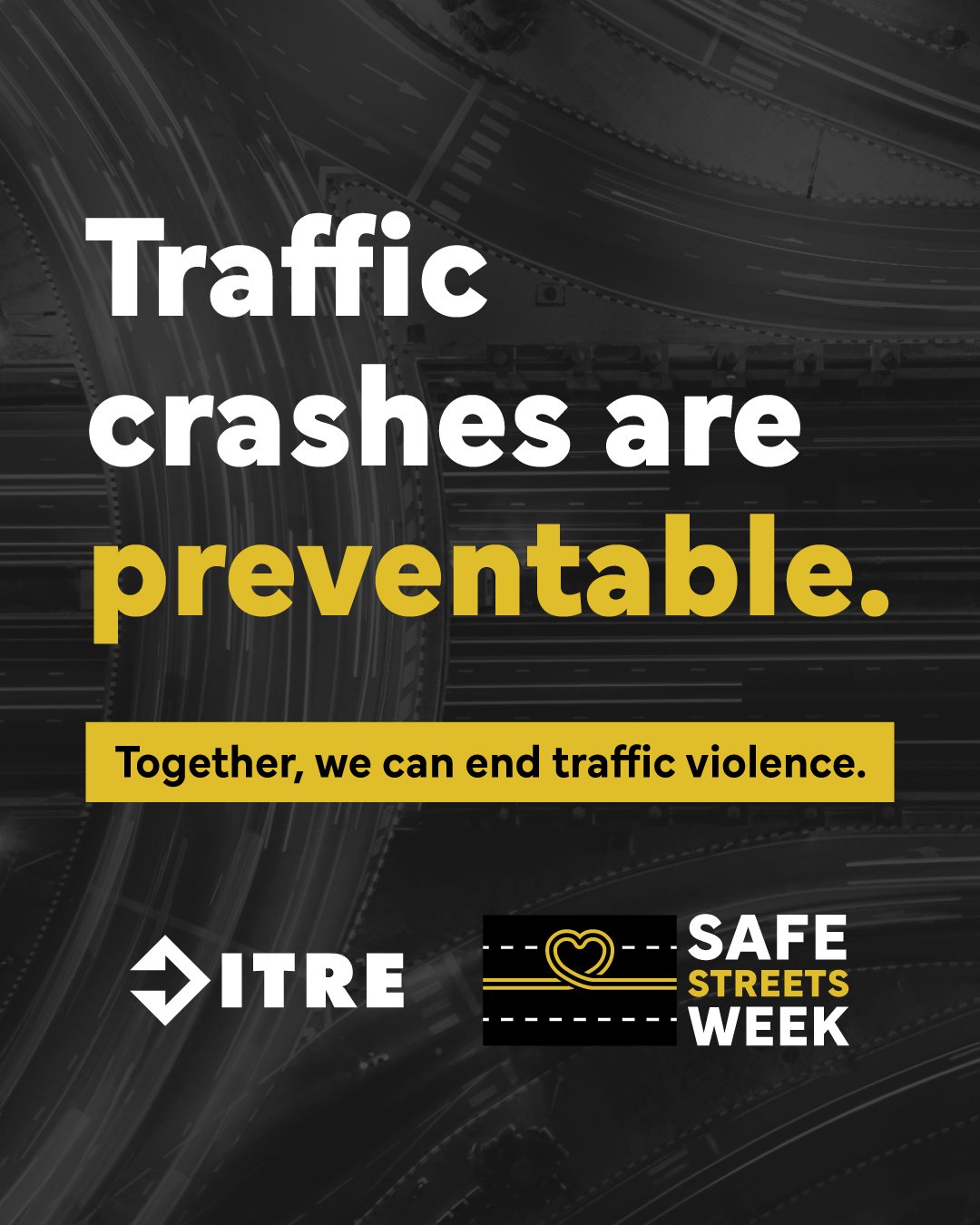
Last year, 1,732 people left for a destination in North Carolina and never made it home. Another 113,602 were seriously injured in a traffic crash in our state.
Traffic crashes are a (top 3) leading cause of death for North Carolinians ages 1 – 44 (Source: NC Department of Health and Human Services).
These numbers are discouraging. But our goal this Safe Streets is to instill hope, because these tragedies are preventable.
There is a growing movement all over the world and in North Carolina, calling for an end to preventable traffic violence. People everywhere are waking up to realize that we don’t have to keep doing business as usual.
For too long, we’ve mentally accepted that crashes just happen. We’ve accepted that our freedom to go to the grocery store, to commute to work, or visit a loved one, comes with an inherent cost – a risk of being seriously hurt or killed in a crash.
This week, we’ll set the record straight. Traffic crashes are preventable. No loss of life on our roads is acceptable. We know how to save lives and prevent road deaths – through the Safe Systems Approach.
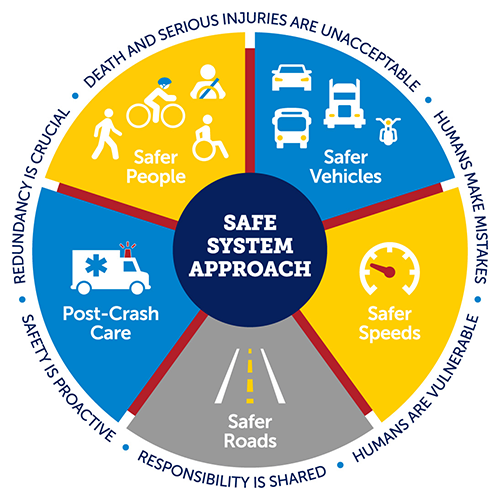
Source: FHWA
The Safe Systems Approach works by creating a transportation system that accommodates human mistakes and reduces the impact energy on human bodies.
Using the Safe Systems Approach, Spain has reduced their road deaths by 80% and Sweden has reduced their road deaths by 67%.
For more information on Safe Systems, click here (Source: FHWA).
Last year, 115,334 families’ lives were forever changed by a traffic death or serious injury on North Carolina roads. But it doesn’t have to be this way.
North Carolinians deserve the right to vibrant, lively communities.
North Carolinians deserve freedom and mobility without fear of getting hurt.
No one should be killed moving around their community on an otherwise normal day.
This is a preventable public health crisis. It’s something we will change.
Activities
Daily Trivia Challenge
How much do you know about road safety? Take our daily 5 question trivia quiz to find out!
Start the challenge
Social Media Content
Group Discussion
Short presentation for staff meetings, classes, or group discussions.
Take Action
There are 18 communities in North Carolina that have committed to Vision Zero, a program to eliminate roadway deaths and serious injuries.
Check out the North Carolina Vision Zero Communities.
Is your community on the list? If not consider contacting your local municipal leaders or transportation department and urge them to commit to Vision Zero.
Feedback & Input Survey

We will not be silent: How to advocate for safety when someone is driving dangerously
You caught a ride with your best friend after school, but she pulls out her phone halfway down the road. You are shocked that she is being so irresponsible, but you usually avoid conflict. What do you do?
Your rideshare driver is weaving through traffic, tailing other cars, and speeding. You don’t know him but you don’t feel safe. What do you do?
Your cousin picks you up from work, but you notice he’s not wearing a seat belt. You don’t want to seem ungrateful for the ride, but you want him to buckle up. What do you do?
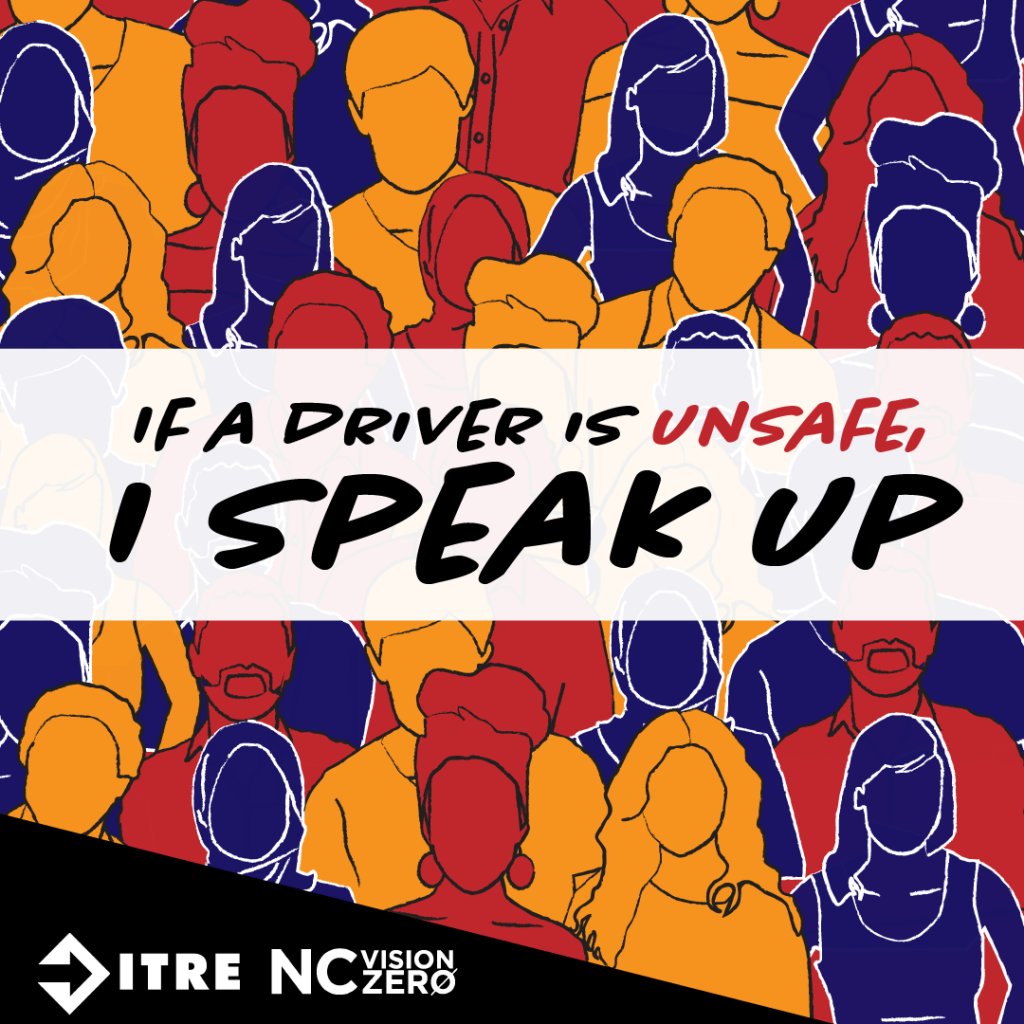
When you’re riding in a vehicle, your life is in the driver’s hands.
In 2021, 273 passengers were killed on North Carolina roads (Source: NCDOT Crash Facts).
So, what do you do if you’re riding with someone and the driver is doing something dangerous? What can you say if you don’t feel safe? It can be difficult, and sometimes awkward, to confront other people about their driving, but it can potentially prevent a crash and/or save lives.
You have the right and the responsibility to speak up if someone is driving dangerously. This makes you an empowered passenger! Just remember to be a PEACH.
The PEACH acronym can help you remember things to say if a driver is being unsafe.

One easy way to encourage a driver to change their behavior is to remind them of the threat of a traffic ticket. For example:
I’ve seen a lot of cops out today, you might want to slow down.
My cousin got a ticket for not wearing a seat belt last week – I think they’re cracking down on that around here.
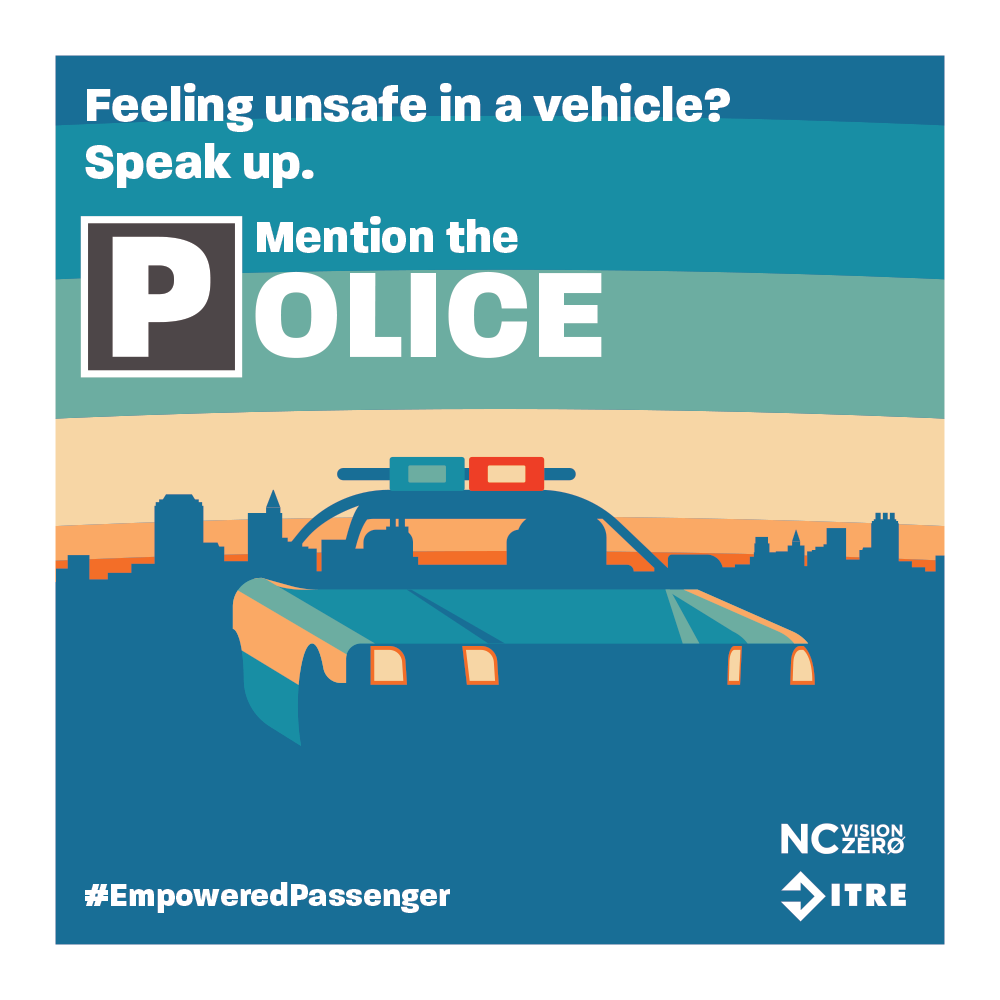
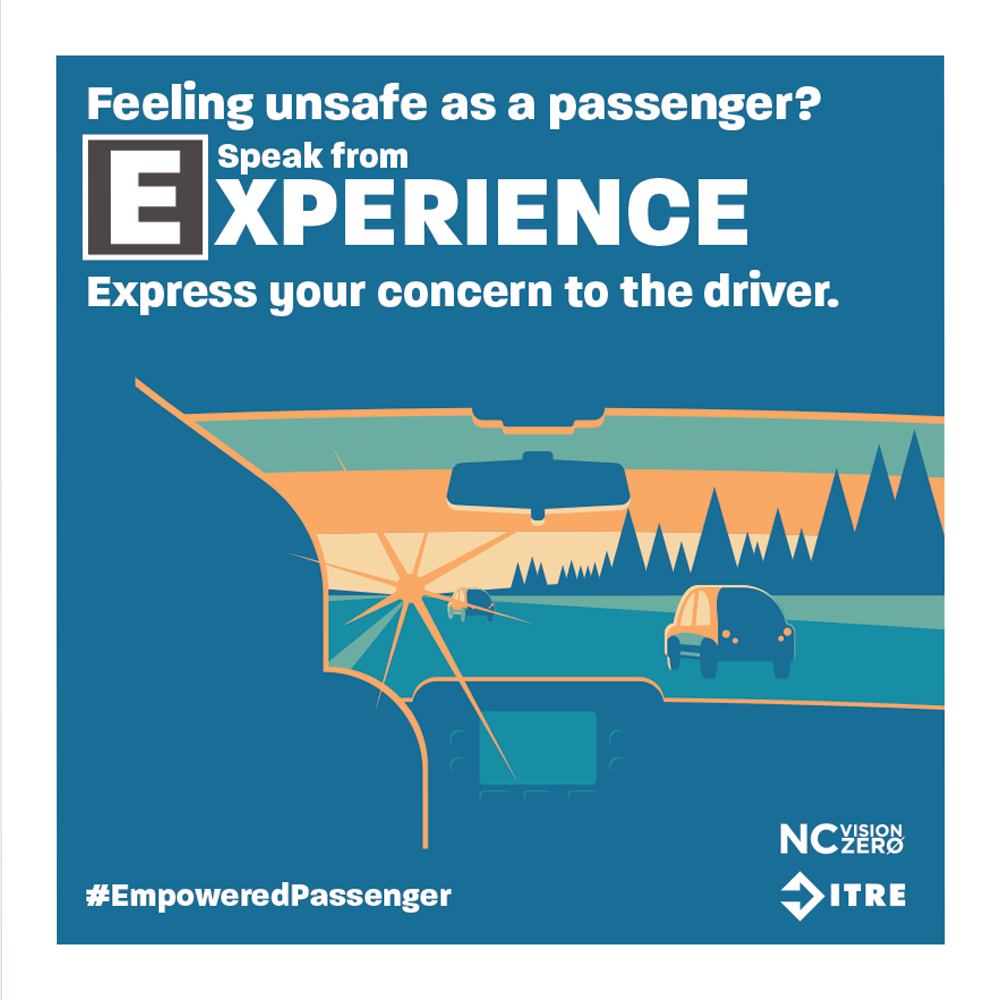
Sharing a story or a personal experience may also help to persuade a driver to be safe.
For example:
My friend got hit by someone driving distracted last week. It really freaked me out.
I read a story this morning about a family killed by a speeding driver. It was heartbreaking.
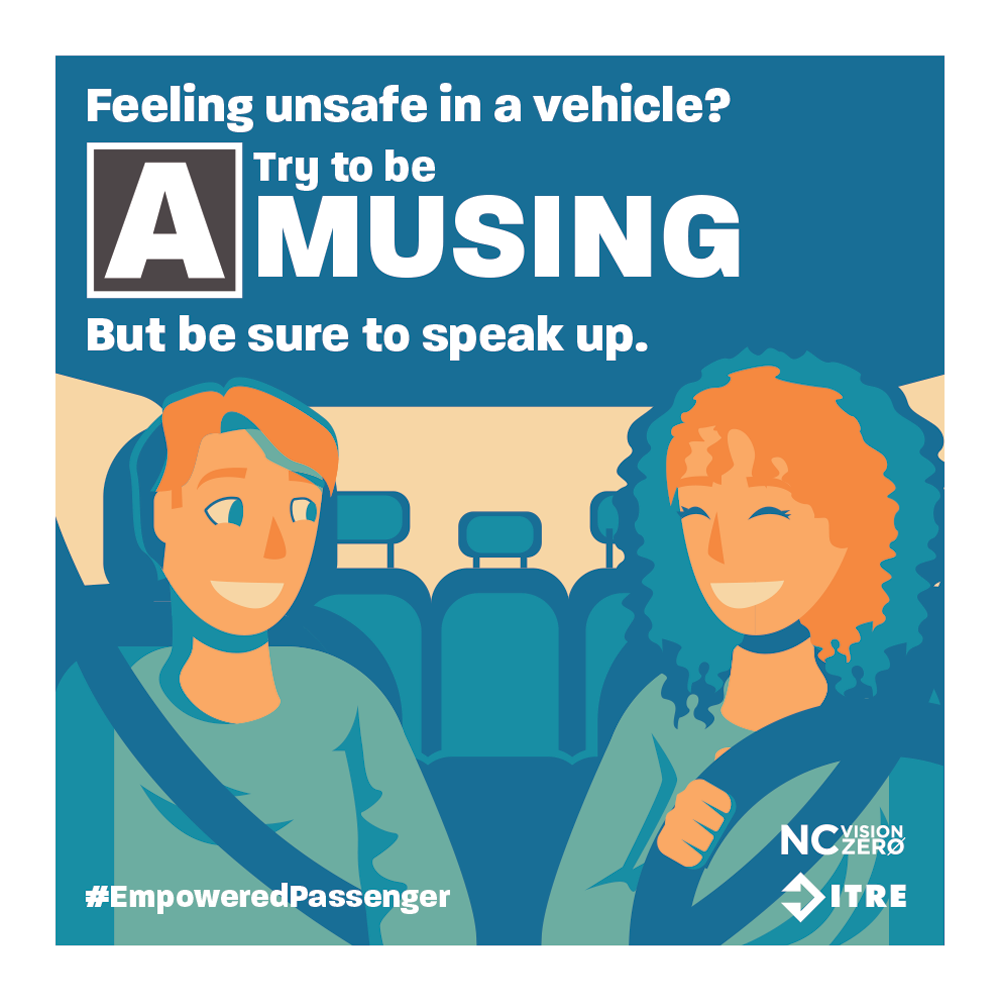
If you can think of joke, humor can also be used to call attention to something that isn’t safe.
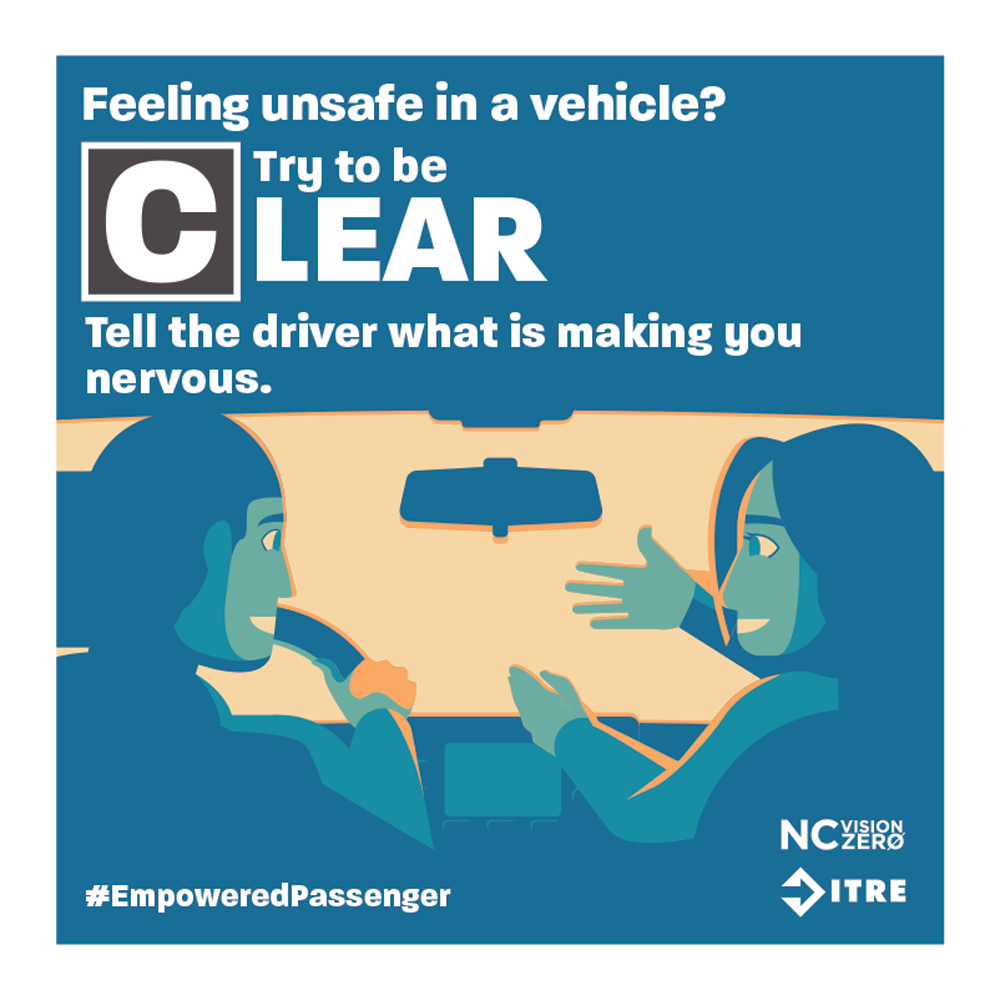
Sometimes being direct is the best option. If you feel safe to confront the driver directly, tell them what is making you nervous and ask them to stop.
For example:
Hey, you’re driving really close to that other car’s bumper. It’s making me nervous. Can you please ease up?
Please don’t use your phone while you’re driving – I don’t feel safe.
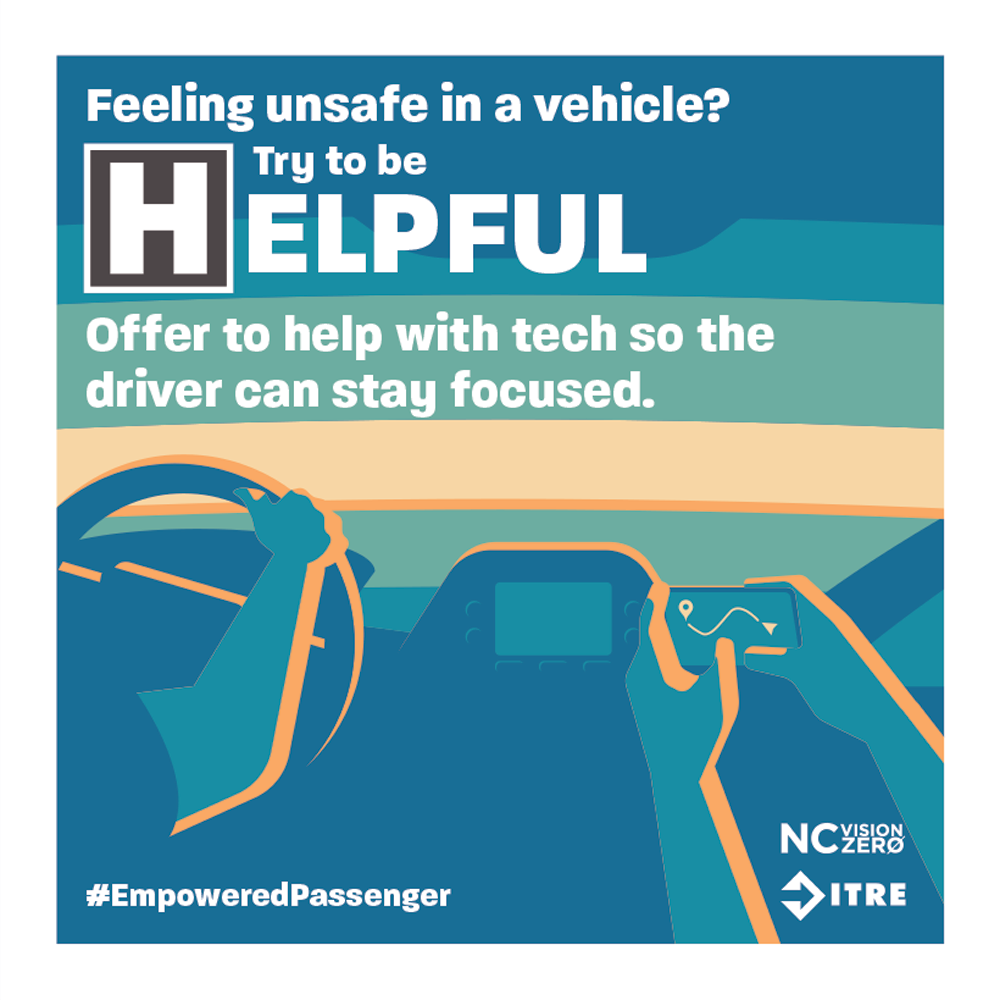
In some cases, it may be easier to offer to help rather than confronting someone directly.
For example:
Here, let me type that for you so you can keep your eyes on the road.
Want me to call them and tell them we’re late so you don’t have to speed?
Lastly, if you have tried speaking to a driver and they continue to make dangerous choices, your safest option is to get out of the car (in a safe location) or refuse to ride with them again in the future.